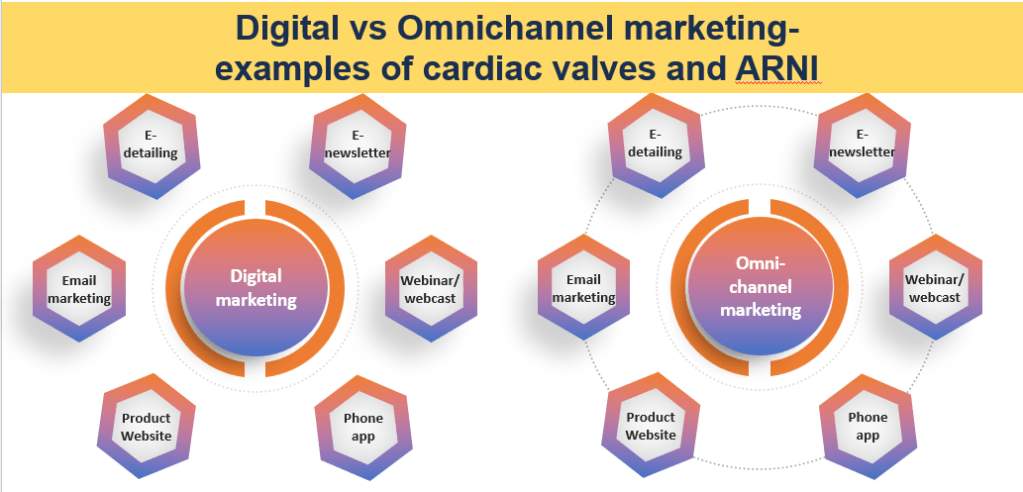
Do both graphics above look similar? There does not seem to be any apparent difference between digital and omnichannel marketing, isn’t it? Look carefully, and you will notice a difference. In the graphic depicting omnichannel marketing, a dotted ring connects all the elements, as if closing the loop. That is exactly the difference between the 2 types of marketing. Though the difference seems very subtle on the surface, there is actually a big difference between the two. So, are you doing digital marketing or omnichannel marketing for your brand? In a fiercely competitive marketplace, omnichannel marketing can be the differentiator to increase your market share. Let us take 2 real-life examples to understand it better. I will take one example from medical devices and one from pharma. While both types of marketing can have multiple channels, I have shown only 6 in the graphic above for the purpose of this article.
Example 1 – Medical devices
Let us assume you are a brand owner of a transcatheter heart valve (THV) used for Transcatheter Aortic Valve Implantation (TAVI). The usual messages one would want to communicate include the design features, the resulting benefits over other valves, the ease of implantation, the sizes, the pivotal studies, other published studies or case reports, and the comparator studies. Through digital marketing, you could include all this information on an e-detailer, product website, e-mailer, e-newsletter, webcast etc. The problem is that the receiver or listener (the interventional cardiologist) might already know some of the information or simply may not be interested in knowing everything. (S)he may be looking for specific information e.g. any head-to-head study with a competitor THV or case reports of it being used in bicuspid valves or in valves with small annuli. In such a scenario, (s)he has to either ask the sales rep for the info, search the company’s website to see if there is any information, or do an internet search. Omnichannel marketing can help in customized marketing. For example, look at the graphic below. You can send an email to the HCP with the following links, which (s)he can access anywhere, any time and read only the specific information (s)he needs. Of course, this is a crude graphic, only meant to explain the concept. It can be designed better. Pls note, the brand name of the THV in the graphic is a dummy name.
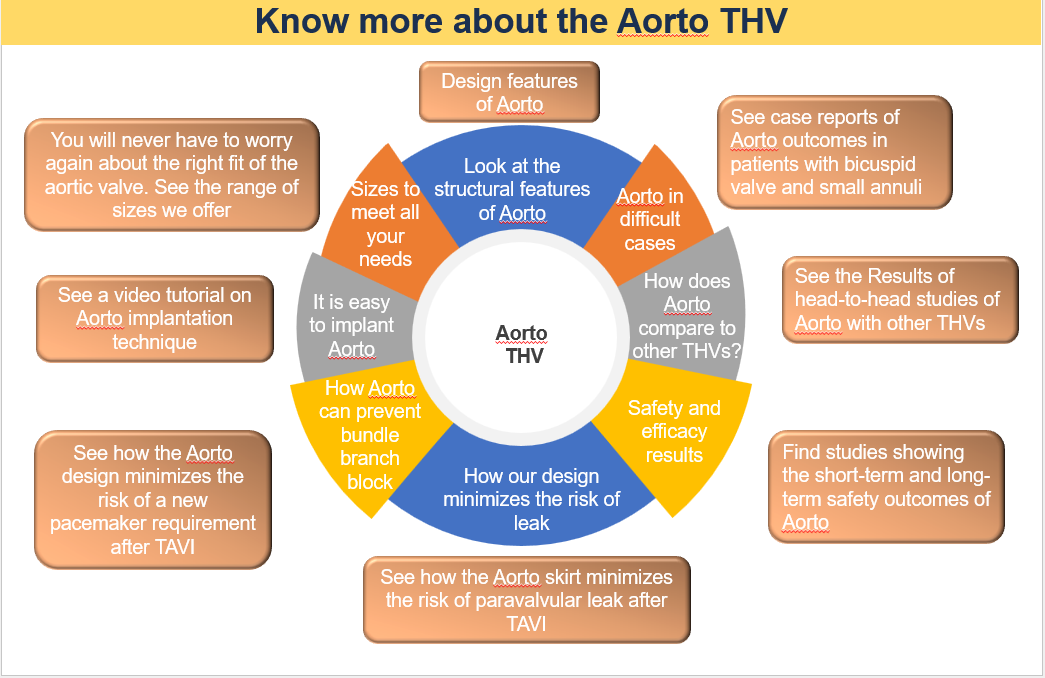
The above graphic is still not perfect for a customized experience. The 3 blocks on the right (about the studies) should take the user to another graphic where (s)he has a choice about which study (s)he wants to read about. Further, a link to the full text is necessary; however, the user should be provided a quick summary of the study design and outcomes through easy-to-read graphics. Every section should ideally end with a call-to-action (CTA) to complete the user experience. This could be about asking for an in-clinic discussion, demo, enrollment for a webinar, discussion or anything else.
Example 2 – Angiotensin receptor/neprilysin inhibitor (ARNI) for heart failure
It almost seems like ARNIs have been discussed as deeply as possible and there is nothing new to talk about, especially for a marketer planning to launch an ARNI brand. All the data about them is known to all cardiologists and the market share taken by the early launchers. Yet, there is an opportunity. New data continues to emerge. However, I would say that there is so much data overload about this drug class that it is crying out for omnichannel marketing. It is impossible for a clinician to remember all the data. I will pick up only one example – the data for various patient profiles.
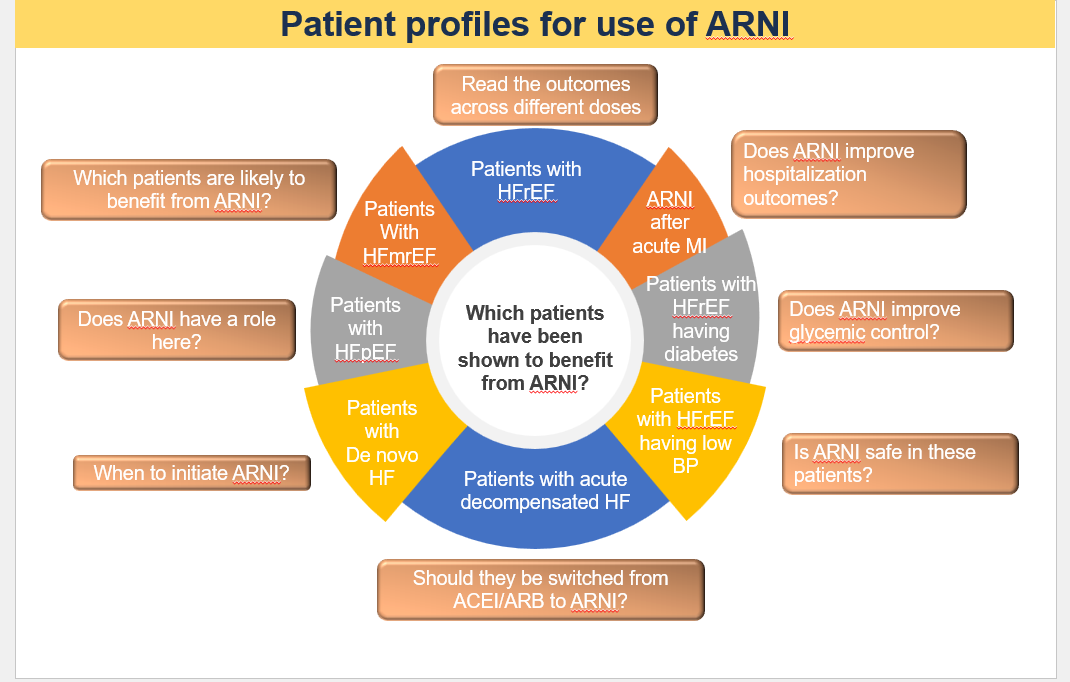
What is shown in the circle above would possibly look like a regular e-visual aid or an emailer. The HCPs by now already know the indications for ARNI. So in all probability, they are not interested in the text in the circle. However, what you see in the boxes around the circle is one sample question related to the respective patient profile that an HCP might have. An HCP could have several questions or information that he/she seeks related to published data about each patient profile. Omnichannel marketing should allow the HCP to choose the questions and get answers to all his/her questions from a single click (imagine a pop-up window that opens when any of the questions is clicked) and does not take him away from the main page. Think of the home page as a roadmap for all information on ARNI that an HCP could require. This saves the HCP’s time as he/she then needs to read the info that he/she requires and not the entire content.
A similar one can be created simply about guideline recommendations for ARNI in different patient profiles. In fact, for every patient profile shown on this graphic, there can be a standalone graphic to dissect the patient profiles further. This kind of ease in perusing information can really help a clinician.
In fact, there is so much more to talk about ARNIs that this single graphic is grossly inadequate for omnichannel marketing. Even a webinar cannot cover all that is known. Such a product provides the best opportunity for omnichannel marketing and absolutely needs it. Digital marketing is simply not enough in this case. You would realize that omnichannel marketing requires not only cutting-edge content but good IT support as well to really make an impact in the market.
I hope the 2 examples would have clarified the mist around these 2 seemingly similar marketing techniques.
 MedicoMindsPro