
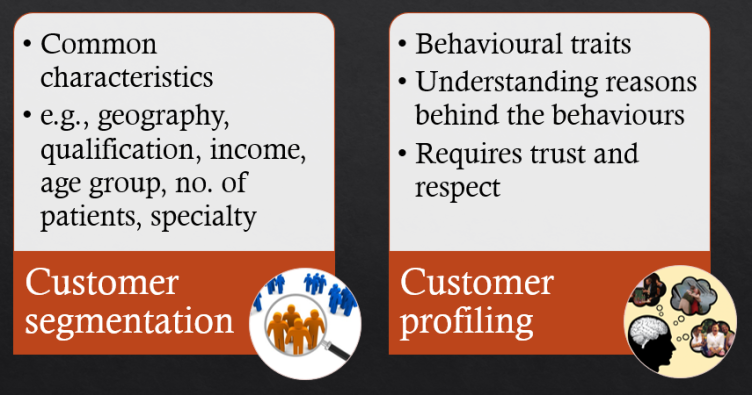
Anyone who has been even remotely associated with marketing has heard about customer segmentation. But what about customer profiling? Are segmentation and profiling the same? In the context of healthcare marketing, which function is best suited to undertake these activities?
In simple terms, customer segmentation means a cluster of individuals with similar characteristics. These characteristics are not set in stone and might vary for different industries. Even within the same industry, they might vary for different companies and within the same company might vary for different business units and different brands within the same unit, especially in the healthcare industry. This is because each product is usually meant for a specific disease condition and the epidemiology of every disease condition varies widely.
So, for example, you are trying to create a marketing plan or introduce a new broad-spectrum antibiotic. We all know there are multiple types of antibiotics and they are being prescribed by all types of HCPs right for general practitioners to superspecialists. You do not want to introduce/promote your product to every HCP. Hence, you decide on a segment that you aim to target. Since it is a broad spectrum antibiotic, maybe the segmentation by indication does not work, unless you want to market it only for a specific indication. The other criteria for segmentation could include- specific geographies, specific practice setup (private clinic/affiliation to a public hospital/ affiliated to a corporate hospital), HCPs with a specific qualification, HCPs with an ‘x’ amount of patient turnover per day, HCP performing ‘x’ number of surgeries per month. This is the easy part as it usually requires only data, which the sales force of most pharma companies has at the tips of their fingers.
What then is customer profiling and how is it different from segmentation? Which function is best suited to profile customers? Here I will take an example from real-life. Assume that the topmost mobile phone manufacturer in the world wants to target a specific segment for a new premium-priced model of its highest-selling brand to be launched in India. Let us assume this segment is the top 6 metro cities, people aged 30 to 50 years and earning more than 25 lacs per annum. Would everyone meeting these criteria be convinced to buy the phone and actually buy it? All of us can relate to this scenario. Some might not buy because they do not think it is worth spending such an amount on a mobile phone, some might have had a bad experience with the brand in the past, others might have other priorities, some others do not perceive the value for that price, and there can be numerous such reasons These are some customer profiles- essentially, behavioural traits of individuals within a segment. Behaviour always has a reason.
Now coming back to our antibiotic- within the segment you are targeting, there will be HCPs who use your antibiotic heavily, others use it more sparingly, while some others do not use it at all. The reasons could vary – not wanting to use a broad-spectrum antibiotic as a first choice, using another broad-spectrum antibiotic as first-line, using your broad-spectrum antibiotic only for specific conditions, price, preference for another brand, pack size, etc. The first 3 reasons have a scientific rationale in the mind of the HCP, and rightly so. His/her behaviour is based on evidence and trying to change his/her behaviour to push your product as a first-line antibiotic could in fact put you in his/her bad books. Putting it very simply, profiling is understanding your customer behaviour and the reasons for the same. This is easier said than done. Unless there is a level of trust and respect between both parties, you might spend ages and yet not get the clue.
The same holds true for devices. In devices, the touch and feel of the product and the level of comfort in handling it are paramount. Such close interactions with HCPsright from the designing stage can help a company design better products.
How does profiling help? Understanding customer behavior helps in customized communication. One size does not fit all. If done sensibly, these behaviors can be used as an advantage for educational initiatives rather than just pushing for prescriptions.
Which function is best suited to elicit customer behavior? Ideally, anybody- be it sales, marketing or medical affairs should be able to do it. All interactions do not have to be about sales. These discussions could be long-term relationships in the making. That said, to understand a physician’s behavior at an evidence-based level, medical affairs is best placed. An interaction with med affairs is more like a peer-to-peer discussion and is likely to be more frank. At least as far as the leading names in a particular therapy area are concerned, it might be good for med affairs to take the lead in customer profiling.
Although the example I have taken here is that of a broad-spectrum antibiotic, which in a sense is a mass-market product, customer profiling is absolutely a must for success with speciality products. It is an essential step after customer segmentation, to engage in customized communication, build relationships, and achieve desired results.

