
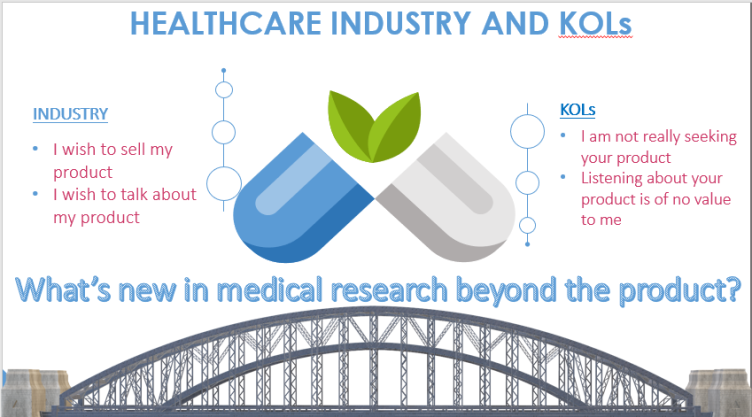
In most seller-customer relationships, the focus is the product/service. The seller wants to sell the product/service, and the customer seeks to buy the product/service. This, however, does not always apply to the healthcare industry (pharma and medical devices). The customer (HCP) has to make a decision about the product on behalf of somebody else (the patient). Moreover, in this industry, the customer is far more knowledgeable than the seller. Further, I doubt any other industry has so many brands of a single product vying for a share of the market. For e.g., there are 325-350 brands of plain paracetamol and 120 brands of plain metformin, which are some of the most commonly prescribed drugs.
There is possibly a third disconnect between the seller and the HCPs, which is entirely avoidable. Inside the clinic, companies and sales reps are communicating to the customer what they want to, in their style, the objective being to sell the product. Rarely do we step back and think beyond our product or focus on what the customer wants. Also, equally important is not just what is communicated, but how it is communicated.
The commonest approach for interacting with KOLs is sales rep visits. Most sales reps end the visit with a leave-behind input (it might just be a small leaflet or a booklet running into several pages), with the hope that the HCP will read it later. The team that creates the input hopes that the HCPs will find it useful and interesting, thus creating a good image of the company in their eyes and helping the brand get more prescriptions. But the fact is that most of these inputs end up in the bin, often unread.
For the HCPs to find value in the industry’s in-clinic communication and inputs, it is important to move away from an inward-looking approach to an outward-looking approach. Let me explain it with 2 examples.
- I will first pick up an example of paracetamol. Since it is a very old molecule with not much new research coming up quite often, most reps promoting this product are likely to either just mention their brand as a reminder or focus on attributes like tablet size, SKUs of various strengths, ease of solubility, palatable taste (in case of syrups), indications like fever, cough/cold, pain, brand legacy, and so on. How long can this hold the interest of the customer? Even when some scientific in-clinic inputs are rolled out, they are usually focused on the product – e.g., a company selling paracetamol will not roll out an input on ibuprofen or diclofenac. The reasoning is, ‘how would it benefit us’? If we are promoting paracetamol, our input has to be on paracetamol, even if these are old studies or new studies with no novel findings. This is what I call an ‘inward-looking’ approach. We talk about paracetamol because that is what we wish to, and not because the KOL is keen to read/hear about it. An ‘outward-looking’ approach would be to think of what the KOL would value, even if there is no mention of paracetamol in the communication. Paracetamol belongs to the therapy area of pain and is possibly used by HCPs of all specialties for various indications. There is a lot of scientific communication that can be created around pain itself. Some examples are- new research in the area of post-operative pain, cancer pain, pain management in palliative care, migraine, different types of arthritis, acute respiratory infections, patient satisfaction with acute and chronic pain management, endometrial pain, compilations of important abstracts from conferences focused on pain, and many others. These could be rolled out as appropriate for the relevant specialists whom the rep promoting paracetamol might be meeting. New and clinically relevant scientific knowledge is what KOLs seek and this outward-focused approach earns respect and builds long-term relationships.
- In the 2nd example, let me pick up the most widely used tool- the 3-fold LBL, as it is commonly known. I mentioned above that more than what is communicated, it is also important how it is communicated. Stories resonate more with any human being, rather than mere sentences. However, in the eagerness to highlight the brand, most LBLs fail to tell a story. When communicating scientific evidence, an LBL that just lists 3 outcomes from some studies (e.g., molecule/device A is more effective than molecule/device B, molecule A acts faster than molecule B, and molecule/device A is safer than molecule/device B) without telling the entire story, is sure to go to the dustbin without being read. How will an HCP blindly believe 3 sentences that have been listed on an LBL? If we are expecting him/her to go and check the references cited, we are expecting too much. In an effort to give more prominence to the brand and make it easy for the sales rep to detail, we are doing away with stories entirely. Instead of 3 sentences on an LBL, I would create 3 LBLs, each focusing on one specific message and providing the complete scientific rationale and the published study in a succinct but visually appealing manner that reads like a story. I would create a complete factual story to support my claim. The target audience for the LBL is the HCP and not the sales rep, and this self-reminder should be on the desk of every marketer and medical affairs professional.
Moving away from the ‘inward-looking’ approach of what I wish to talk/do to an ‘outward-looking’ approach of what I should do to add value to the KOLs is what aces the game. In fact, even when you have run out of ideas, the KOLs will happily come forward and even suggest ideas once you have managed to occupy their ‘mind-space’ as being a scientifically focused organization/team.

