
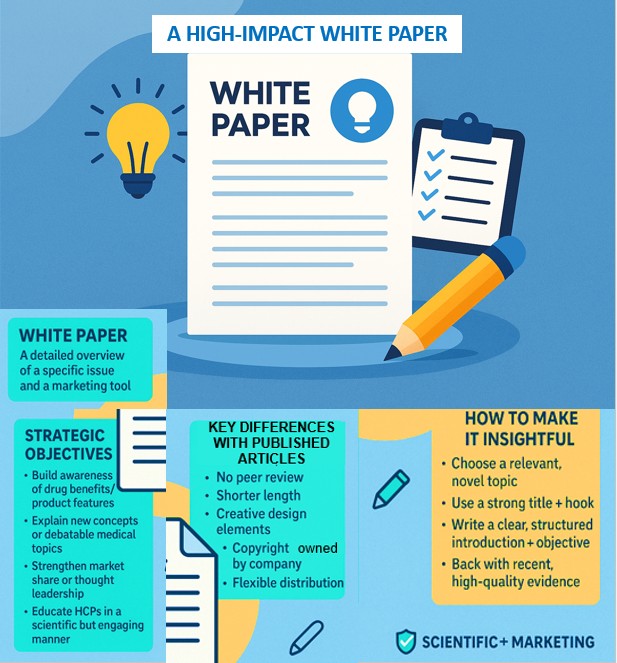
If you have seen a white paper, you would have realized that it often looks like a journal article or manuscript. So then, what is a white paper, who publishes it, when, and why?
Well, technically it looks similar to a journal article, but there are major differences that are not obvious when you read the content. Journals have 2 types of articles that can be said to resemble a white paper- these are original research articles and narrative reviews. The latter resembles a white paper more closely. As we know, an original research article is based on a single study and cites similar other studies in the Introduction and Discussion sections. The author(s) of an original article are the ones who conducted the research. Whereas a narrative review is an article on a specific topic, which is completely written by referencing existing literature i.e., the authors are not presenting the outcomes of a study they have conducted. A white paper is similar. The key differences between a white paper and a published narrative review in a medical journal are:
- The author of a narrative review is usually a known specialist in his/her field e.g., a KOL. The journal would ask for the credentials of the author(s). In fact, most leading journals do not accept narrative reviews anymore or accept only those that they invite specific KOLs to write. However, a white paper can be written by anyone- an HCP or marketing/medical affairs personnel or anyone else. This is because a white paper is not written for publication in a journal but is distributed to anyone the writer(s) wants to share with.
- A narrative review published in a scientific journal is peer reviewed. Since it is peer-reviewed, the author(s) need to balance arguments in favor as well as against the topic (unless there is absolutely no evidence for one of the two scenarios). The objective of the narrative review is to share medical knowledge with specialists from the same field. A white paper is more of a marketing tool. Nevertheless, in pharma and medical devices, since white papers are usually distributed to HCPs, they should also try to present both sides of the coin in order to earn their respect.
- A narrative review can/might be cited by other publications in the future while a white paper cannot be cited even if it is released online.
- Although there are no strict rules as such, white papers are usually shorter than manuscript articles (at least in the context of the healthcare industry). This might be because a very long white paper might not be completely read by the HCP since it does not enjoy the credibility a published article does.
- While the journal that publishes an article holds the copyright of the article, in the case of a white paper, the sole copyright is that of the author(s) and/or the company that circulates it.
- Since the owner of the white paper is the company, there are no restrictions on the number of prints that the company wants to circulate or the channel through which they wish to release the white paper. It could be even released on a company’s website or on social media or anywhere else.
- One can take more creative liberties with a white paper e.g., use of infographics or writing about a brand, which is more useful in the case of medical devices and equipment.
In the context of the commercial healthcare industry, white papers are indeed marketing tools published by a healthcare company. It is usually to build awareness about the benefits of a drug, product feature, or new concept. Some examples could be- pleotropic benefits of SGLT2 inhibitors, design features of a particular prosthetic cardiac valve that could lead to superior outcomes, why is India lagging behind in the use of patient-controlled analgesia, does strut thickness matter in coronary stents, etc. The major objective of these white papers is either to increase awareness about the topic, increase the use of a product, market expansion, or gaining market share. Of course, there is no requirement for a review by KOLs or any specialists since this is not a journal publication- although it might be a good idea to run it by some specialists in the field, if feasible. Usually, the author’s name is not mentioned, and it can bear the company logo if the company desires to.
Well-written white papers that increase the knowledge of HCPs can indeed earn respect from them, particularly if they don’t overtly look like marketing materials and have a robust scientific feel to them. In fact, once that respect is earned, HCPs might look forward to receiving your white papers and reading them as well. So how can one write a ‘good’ white paper? Here are some tips to follow:
- Choose a topic that is relevant to current practice and will be of interest e.g. a white paper on the importance of regular monitoring of BP in hypertensive patients is unlikely to be of interest although it is relevant to practice- unless there is some information that is not commonly known. This leads us to point number 2.
- The title of the paper- The title is the initial hook that will evince interest e.g. for the topic of regular monitoring of BP in hypertensive patients, maybe you are presenting evidence that monitoring should be at different intervals for different levels of hypertension (this is a hypothetical example).
- After the title, there should be a short Introduction section providing the objective of the white paper and highlighting the uniqueness/ novelty of the content. The title and Introduction sections will decide whether the reader reads the white paper.
- The content should be organized into various sections, each having its own heading. The source of the content should be published evidence in leading journals with a high impact factor and should be as recent as possible e.g., for writing a white paper in 2022, I would not look at literature published before 2018. In some cases, there might not be many recent publications- yet I would not select anything before 2015. In fact, if most of the evidence is old, I would mention it in the white paper.
- While the objective of the white paper is marketing, in the case of the healthcare industry the readers will be HCPs- a highly knowledgeable audience, which knows much more than the writer(s). Hence, a good way to enhance credibility is also to present some evidence against the message you want to propagate but justify why you think the argument in favor of the message is stronger. e.g., studies that are against might have a small sample size or might have been conducted among specific ethnic groups, or might not be RCTs etc. By providing a balanced argument you earn credibility and respect from the HCPs.
Before releasing and distributing the white paper, it might a good idea to circulate it among colleagues in the team to get their feedback about the ease of understanding, the messaging they decipher from it, and whether there is some balance between for and against. Of course, the best would be pilot testing to get some feedback from HCPs before sharing it with a wider audience.
Below is a sample white paper attached. Let us say we have a drug X that improves endothelial function. Clinicians might be aware of the indications for drug X, but might not be aware of the endothelial benefit of the drug. Due to this lack of awareness, there might be clinical scenarios such as:
• Some patients who could have better outcomes with drug X, are receiving drug Y or any other drug for a disease condition ABC.
• There might be some other patients in whom drug X given as add-on therapy could improve outcomes due to its endothelial benefit but in clinical practice drug X is not being given as add-on therapy.
• Drug X might be kept as reserve therapy for more severe cases or when nothing else works, whereas, initiating it early in the disease might slow down the disease progression
This is a short version to give you an idea of what it looks like. It will expand with the addition of specific data/studies in each section. Typically, white papers range from 15 to 25 pages, depending on the topic and objective. Note how each section ends in a way that the story smoothly flows to the next section in a continuum (highlighted in yellow).

