
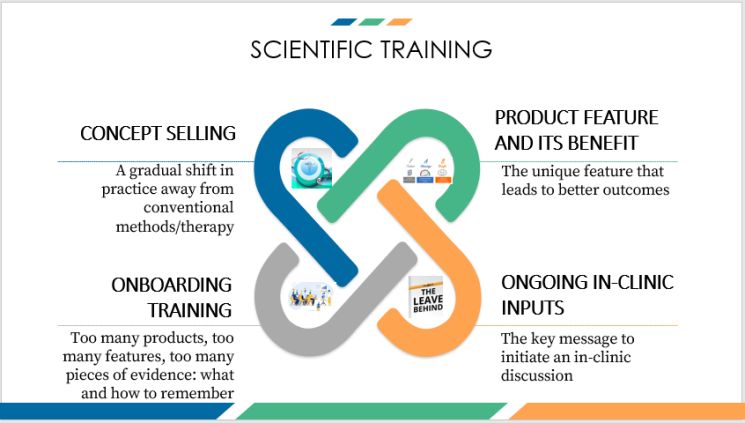
In this part 2, we look at the most difficult part of sales rep training, the scientific pieces of evidence in favor of the product/product feature. The aim of the marketing or medical affairs professional might be either to bring about a gradual shift in practice away from conventional methods/therapy or highlight evidence in favor of a product feature to indicate that the presence of the feature leads to better outcomes. I will provide an example here. Maybe core temperature monitoring is not conventionally being done for gynaecology surgeries. There might be scientific evidence/guidelines about why monitoring core temperature in such surgeries is essential and the risks of not following this practice. By propagating evidence over a prolonged period and at regular intervals, there is an attempt to bring about a gradual shift in practice so that more and more gynaec surgeons start monitoring the core temperature. Whereas an example of highlighting evidence in favor of a product feature to indicate that the presence of the feature leads to better outcomes could be how a combination pack of an antibiotic with capsules of lactobacilli could reduce the adverse gastrointestinal effects of the antibiotic.
Usually, the sales rep training regarding communication of scientific evidence is done in 2 ways- one, the onboarding training of a new rep where the curriculum includes numerous studies related to the benefits of a product. What we might often forget is that much of this training is to create a robust foundation of scientific knowledge about the product before the rep goes on the field. However, many of these studies might have already been promoted as inputs earlier. The rep needs to be clearly informed about it and also that this is being covered in the training to convince him/her about the product benefits. Only if the rep is confident about the product will he/she be able to sell. This also gives the rep an idea of what kind of scientific communication is likely to be rolled out going ahead and what concepts are the marketing/medical affairs team likely to focus on. Nevertheless, the main take-home message from each of these studies should be clearly highlighted so that the trainee is not overwhelmed with the information and also knows what to focus on in case (s)he needs to go through the training material again.
The second type of scientific training is regarding the regular scientific inputs as and when they are rolled out. Some of these might be for only in-clinic detailing, while others might be leave-behind literature (LBL). What I have often seen is that the LBL is handed out just saying, ‘Dr, this is for your reading.’ It cuts a very sorry image in the eyes of the HCP, while a rep who is able to describe the content clearly wins attention. The first step in this training should be- the one sentence that the rep should remember without fail, which can be used to initiate the discussion about the input and also if the HCP is unable to provide adequate time for a discussion. The one sentence that is the take-home message of the input. It might happen that this message draws attention from the HCP and the rep is in fact allowed 2 min for a discussion. The inputs, especially the non-LBLs should be less text and more infographics so that a rep with an average flair for scientific discussion is able to detail it as well. Over a period of time, this builds confidence and a probability of the 60% reps in the ‘average’ category moving to the ‘good’ to ‘excellent’ category.
Most reps promote multiple products and also undergo training on various products during onboarding. I have often seen these onboarding training programs lasting 1-2 weeks. It can get really overwhelming. In these times of easy multimedia options, maybe we can prepare just 5-slide videos around each product and its key scientific message that can be accessed over the phone. The ample waiting time outside the clinics can be used productively. The same can be done with monthly/quarterly scientific inputs. Maybe a single video comprising say 8-10 slides – one slide per product, just showing the one-liner the rep needs to remember while initiating discussion on the input or leaving the LBL.
Last but not least- don’t use jargon when explaining science. The attached graphic shows some examples of how we inadvertently pick up content from publications and use it for sales training and how a simpler version takes more effort to create but is more effective.

As marketing and medical affairs professionals, there is a lot we can do and should do to make the sales rep’s life and in turn our life easier.
 MedicoMindsPro