
A good number of my clients ask me to regularly provide content for in-clinic inputs. In-clinic inputs in the form of leave-behind literature or LBLs as we commonly know them have been and continue to be an important tool in pharma and medical devices marketing. The challenge is that possibly every sales representative who meets the HCP carries an LBL, which is left behind in the HCP’s chamber. Certainly, the HCPs have no time to go through the heaps of them unless there is something that adds value to their practice. It could be a new product, patient education material, or scientific input.
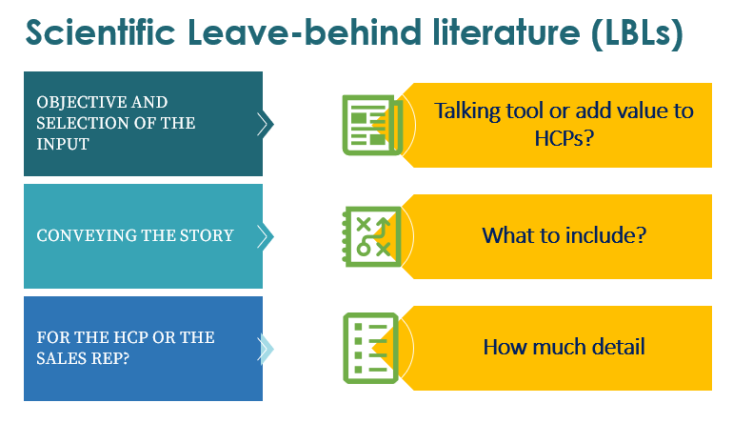
I will not cover the new-product-related LBL here because that is a separate topic of discussion in itself and the basics are widely known- highlighting the feature-benefit, how it is superior to existing options, patient profiles most suitable for the product etc. I will cover patient education material in a separate edition. In this edition, I will focus on LBLs pertaining to scientific inputs, which are the most challenging among the 3 types. We will look at it from 3 angles: the objective and selection of the input, conveying the story, and lastly the most difficult question- should it be sales rep focused or HCP focused. We all know that LBLs are for the HCPs and yet at times we inadvertently end up making them sales rep focused.
So, the first question is- why do you want to create LBLs? Is it because the sales rep must have some tool to talk with the HCP every time he/she enters the chamber? Or is it because you really have new scientific information that is likely to be of interest to the HCP? Or are you trying to build concepts thereby influencing/changing practice patterns based on robust evidence? If the only objective is a tool for the sales rep, it is a wasted effort. The LBL will go to the dustbin the moment the rep leaves the chamber.
New scientific evidence that will interest the HCP has to be novel- something that adds to his/her knowledge and is clinically implementable or something that encourages him/her to try changing his/her practice pattern with respect to a particular therapy/ medical device. For e.g., sharing one more scientific study showing the efficacy of amoxycillin in upper respiratory tract infections is not likely to be of interest since this fact has been known for decades.
Assuming you have found novel literature for your LBLs, how it is presented is very important. This can make or break what you are trying to achieve by sharing the LBLs. We know that it has to be succinct (maybe not more than 2-4 pages) and should have more graphics than text. However, it cannot be succinct to the extent that you share the title of the study and then only the results in the form of graphics. For a clinician, this information is too little to influence him/her. I have seen LBLs that look like this: the title of the study (copy-pasted as in the original article), the number of patients in each arm (this little information with no other details occupying one full page), 2-3 key outcomes, and conclusion. When this client approached me for LBLs to be created for the next 2 quarters and briefed me about the objective, I asked for copies of old inputs so that the story could continue over the months to build the concept. When I saw the LBLs, I asked why there were no details. There were 2 reasons: 1. We didn’t want to have too much text 2. Our sales reps will not be able to detail anything more complex.
This brings me to the title of this write-up. Are we creating LBLs for the HCP or for the sales rep? We cannot skip essential details just because the sales rep will not be able to detail them. For an HCP it is imp to know the objective of the study, the patient profiles included, and any other relevant details about the Methodology. All primary outcomes have to be mentioned and at times also a few key secondary outcomes. The same goes for case-report-based inputs. Important details cannot be skipped. There are ways to present this information succinctly even if it is textual. Talking of detailing, a smart marketer knows this limitation and would train the sales rep to speak only a single sentence about the study, enough to evince interest in the HCP to read it. At the same time, the rep will not take too much of the HCP’s in-clinic time. Over a period of time, the HCP will value the inputs and the sales rep from such an organization!
 MedicoMindsPro