
Successful communication is all about brand recall. Nowhere is it more true than in healthcare, where hundreds of branded generics vie for attention in pharma and several me-too products compete in the medical devices space.
It can be very helpful to have a well-laid-out scientific communication plan right at the beginning of the year, in sequential order. However, it also needs to be adaptable to anything new that comes up.
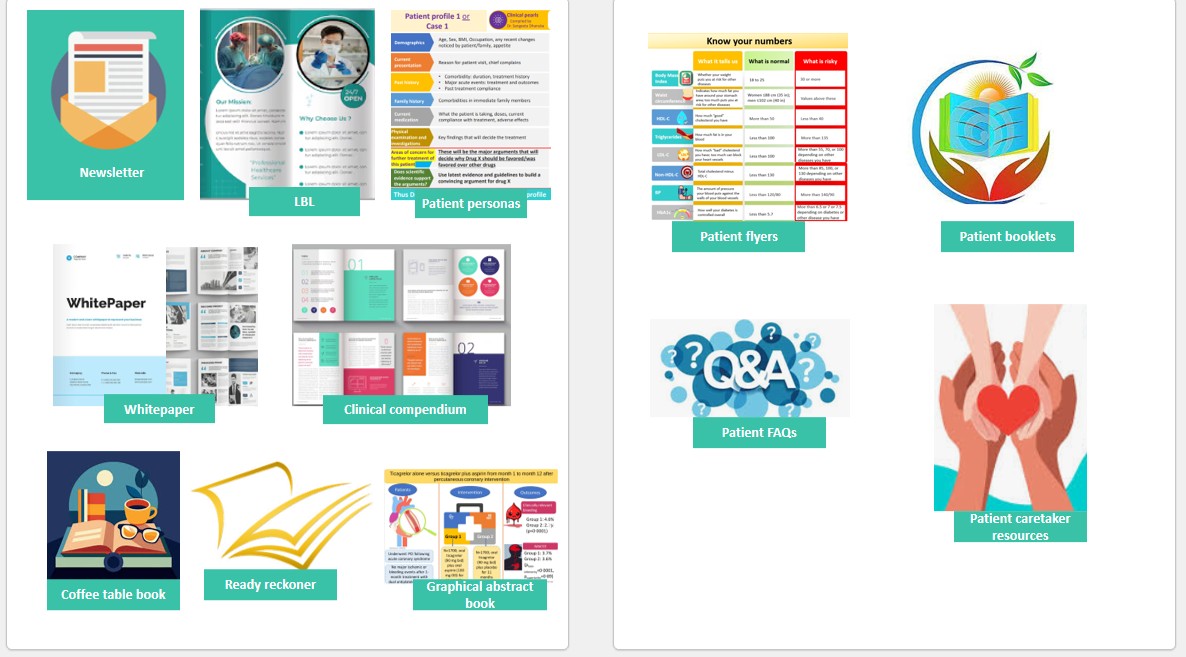
The standard brand reminder LBLs, month after month, the unscrupulous sampling, the generic CMEs and ad boards with no value addition to the HCPs, won’t work anymore in the crowded space. I have put together below a list of various communication tools that can be used, and what works best when (with examples). These will help you plan for the entire year.
- The good but old LBL: Well, it’s not obsolete yet, if used correctly. Use it not as a brand reminder but to share something that draws attention. For e.g., a recent publication related to the HCP’s therapy area or your product. However, how you choose is important. For a cardiologist, sharing yet another study showing the long-term benefits of telmisartan in hypertension won’t work. That is already known. Can you share something that is novel?
- Story-based scientific updates: Medical literature can get boring, and pharma struggles to find innovative ways of communication. Storytelling is very effective because everyone loves stories. See here, some examples of real-world conversation-style scientific communication that uses emotions https://medicomindspro.com/case-studies-and-samples/#emotion
3. The LBL’s cousin, the humble newsletter: A very powerful tool that can be used very effectively. Plan a series that will run over a period of some months with a new edition at fortnightly or monthly intervals. Usually, scientific newsletters should aim at sharing newer concepts and data related to a product (not a brand) or disease area. I have shared 3 ideas for what type of content can go into it here https://medicomindspro.com/creating-a-scientific-newsletter-series-for-pharma-medical-devices-marketing/
4. White paper: It is usually used to build awareness about the less widely known benefits of a drug, product feature, a new concept, or to discuss debatable topics e.g., are some PPIs safer for patients on anticoagulants, design features of a particular prosthetic cardiac valve that could lead to superior outcomes. Unlike newsletters, a white paper is a very detailed document and is stand-alone (not published in series). Read about how the flow of a good white paper should look, here https://medicomindspro.com/white-paper-what-is-it-and-how-can-it-be-made-insightful/
5. Clinical compendium: This can also be published as a standalone or a series. It can be a collection of real-world case reports obtained from physicians with the patient’s identity hidden. The physicians’ names can be revealed if consent has been taken. These types are especially helpful in medical devices. In pharma, it can be used to compile useful abstracts from international conferences, or if you want to run it as a series, pick a new topic for every edition and share studies published on that topic in the last 3 months e.g., all studies on the cardiac benefits of empagliflozin published in the last 1 year. Remember the copyright rules and do not copy-paste the content, for it can land you in serious trouble. There is no need to rewrite the entire study, but aim to create a good flow covering every study in 2-3 pages.
6. Coffee table book: This should be for light reading while still being scientific. To give an example, if I still wanted to talk about the cardiac benefits of empagliflozin and keep it as a light reading, I might start with how SGLT2s came into the picture in diabetes treatment, what led to their discovery, how dapagliflozin was followed by empagliflozin, how the focus shifted to their cardiac benefits, and then just present the studies on cardiac benefits of empagliflozin as graphical abstracts.
7. Patient personas: These are useful to influence practice patterns in case of products with multiple indications or approved for use across various patient profiles. A small flip book or e-book as a compilation of patient profiles for which the drug/device is indicated and found to be beneficial could be a very helpful tool in influencing the use of the product. Similarly, it can be very useful when an approval has been received for a new indication or when guidelines change to allow the use of a product from a 2nd o 3rd line to first line or for an additional patient profile. See samples of patient personas here https://medicomindspro.com/case-studies-and-samples/#patientcards
8. Ready reckoner: These should be things that a physician would like to keep handy. e.g., a ready reckoner of differences between the guidelines, or algorithms of the guidelines, or even clinical scores for risk calculation/ prognosis. Here is an example https://medicomindspro.com/case-studies-and-samples/#flipbook
8. Graphical abstract book: I would call it a visual version of a newsletter for compilation of the latest published studies related to a therapy area. Instead of going into the details of every study, we can just create graphical abstracts of each that look interesting and take only a few seconds to read. See some samples here https://medicomindspro.com/case-studies-and-samples/#abstractbook
9. Patient flyers: These could be just like LBLs that a physician can hand over to a patient as a guide, e.g., important numbers that you should know, DASH diet plan etc. See an example here https://medicomindspro.com/case-studies-and-samples/#knowyournumbers
10. Patient education booklets: These should be more detailed and focus on a single disease area e.g., different topics under diabetes care, or a specific cancer and its treatment.
11. Patient FAQs: This format is more useful for patients who are scheduled to undergo or have undergone a procedure. There might be several questions in patients’ minds that they might not recall during consultation or might be too embarrassed to ask.
12. One-minute case capsule: ⏱️ 1-minute case capsule for a quick scientific update. We all know about the demand for short-format content in all spheres of life. With several digital resources for medical updates and several marketers vying for attention and pushing content as scientific updates, clinicians are hard-pressed for time to go through the deluge of content, just like everyone else.
Case reports are always more popular among clinicians as they add a lot of value to their practice and feel relatable. How about 1-minute case capsules that one can go through even between seeing 2 patients or walking to the car or during that tea/coffee break? Of course, the skill needed here is to pick up cases that are useful for a clinician. See a sample here https://medicomindspro.com/case-studies-and-samples/#casecapsule
12. Patient caretaker resources: The most forgotten community in the healthcare landscape but can make a huge difference to the outcomes. Moreover, they need as much empathy as the patient, especially in case the patient has a chronic debilitating illness, a terminal illness, or a rare disease. They need guidance about not just managing the disease but the daily small and practical struggles that they face as they care for their loved one. For the patient and caregiver resources, always have less text and more graphics. See an example here https://medicomindspro.com/case-studies-and-samples/#caregivers
You can find samples of some of the above inputs on this page https://medicomindspro.com/case-studies-and-samples/
With this list of ideas, I am sure planning your inputs for the year will be a breeze. Most ideas will work for all kinds of products. However, remember, before you begin, your medico-marketing strategy should be in place. Need a quick brush-up on creating one? Click here https://medicomindspro.com/creating-a-medico-marketing-strategy/
And if you need someone to create the strategy or any of the above inputs for you, just send me a DM.
 MedicoMindsPro