
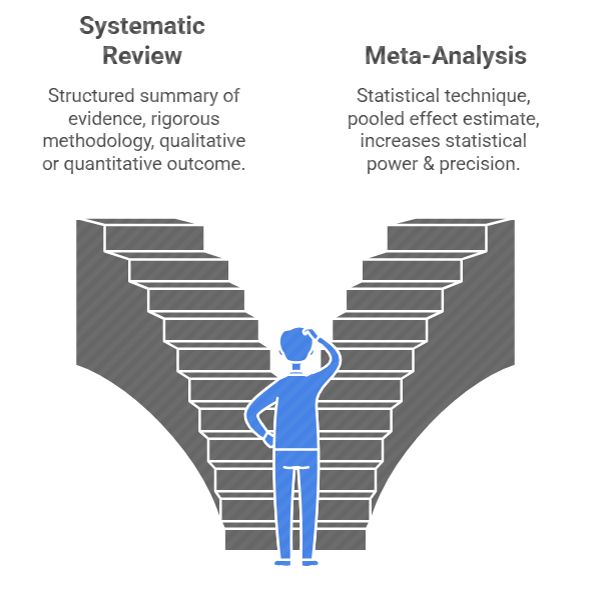
Systematic review and Meta-analysis are often considered one and the same thing, but they mean different things.
Systematic review = methodical collection + critical appraisal + synthesis of evidence.
Meta-analysis = statistical pooling of data (often as part of a systematic review, but not always required).
Here is a more detailed explanation:
Systematic Review
✅ A systematic review is a structured summary of all available evidence on a specific research question.
✅ It follows a predefined search strategy known as the PICO framework (Patient/Population, Intervention, Comparison, Outcome). The period for which studies will be considered is also often predefined.
✅ The outcome may be qualitative (narrative description of the evidence) or quantitative if combined with statistical analysis.
✅ Example: A systematic review of RCTs on Drug X in diabetes might describe each trial, its strengths, limitations, and overall consistency of results.
Meta-Analysis
✅ A meta-analysis is a statistical technique often conducted within a systematic review.
✅ It combines numerical data from multiple studies to generate a pooled effect estimate (e.g., overall hazard ratio, odds ratio, or risk difference).
✅ This increases statistical power, improves precision, and can help identify trends not apparent in individual studies.
✅ Example: A meta-analysis might calculate the combined survival benefit of Drug X across all trials, giving a single pooled hazard ratio.
Use a Systematic Review when:
🔷 You want a comprehensive overview of all available evidence on a PICO question.
🔷 The studies are too heterogeneous (different populations, interventions, outcomes, or methods) to allow statistical pooling. e.g it may not be right to combine studies on empagliflozin+metformin with those on empagliflozin+sitagliptin or studies in patients on oral antidiabetics at baseline vs those on insulin at baseline in whom semaglutide was initiated
🔷 Evidence is limited in number or quality, so statistical combination would be misleading.
🔷 The objective is to summarize, appraise, and highlight research gaps rather than provide a pooled estimate.
Use a Meta-Analysis when:
🔷 There are multiple comparable studies addressing the same question, with reasonably similar designs, interventions, and outcomes.
🔷 You want to quantify the overall effect size (e.g., hazard ratio, odds ratio, mean difference).
🔷 You want to explore subgroup effects or heterogeneity across studies.
Example: Pooling survival outcomes from multiple RCTs evaluating the same drug in breast cancer.
🔷 Explore the outcomes of a drug in various subgroups by combining studies with similar designs, interventions, and outcomes.
In practice, most meta-analyses are embedded within a systematic review. First, a systematic review is conducted to identify and assess studies, and then a meta-analysis is conducted if pooling is appropriate.
 MedicoMindsPro