
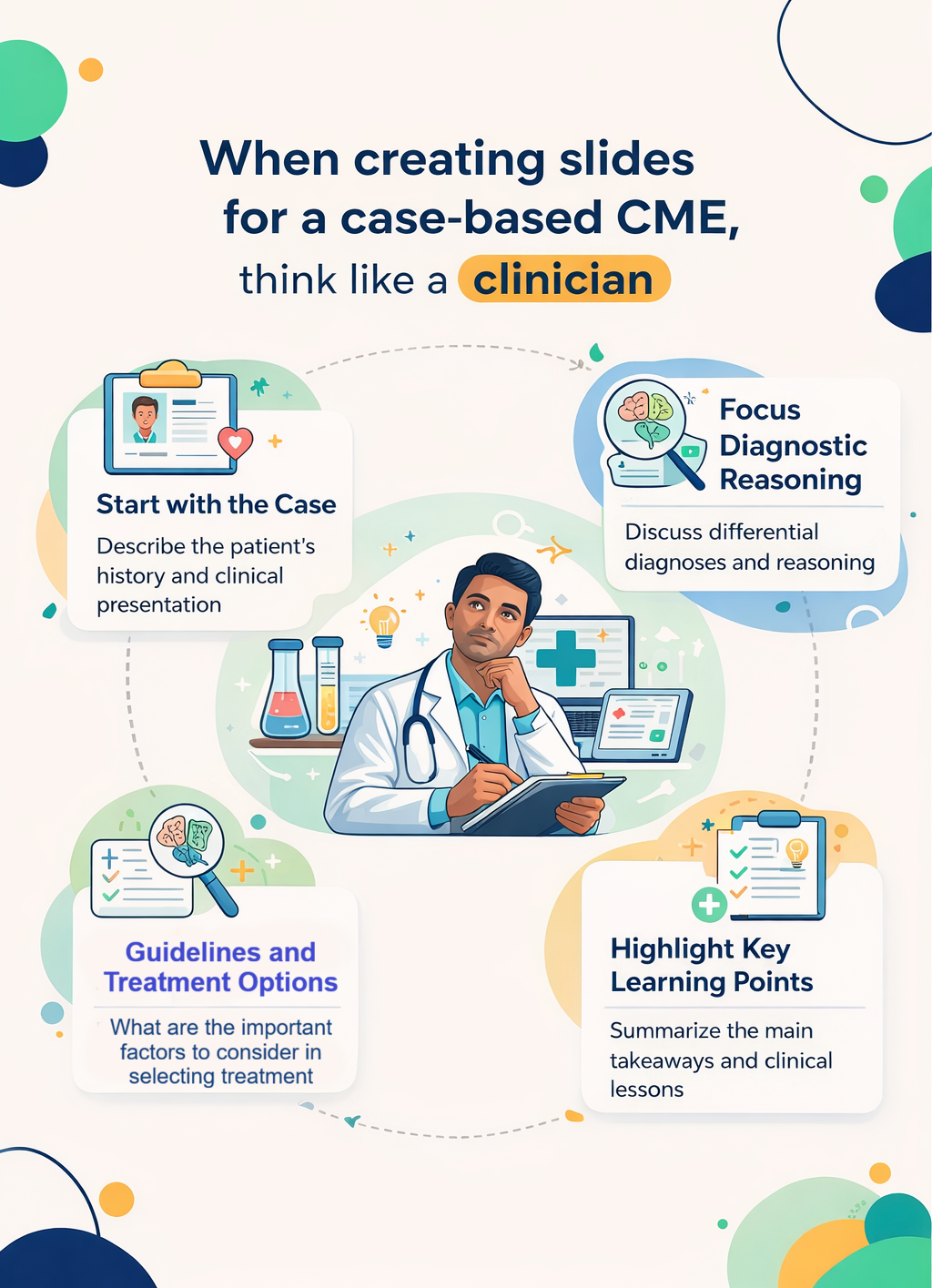
Case-based CMEs are the most popular and effective CMEs because clinicians can relate to them and take back something useful if the discussions are engaging. Without discussions between attendees, they can get boring, though!
This can happen either if very routine cases are presented or the flow of the presentation is unlike how a clinician thinks.
We often see CME slides where the case, its treatment, and outcome are all discussed in the first 2 slides, and the remaining 50 slides are a very poor copy-paste of algorithms from guidelines or long tables from studies, which are illegible on the slides. And imagine a 50-slider for a case presentation!!
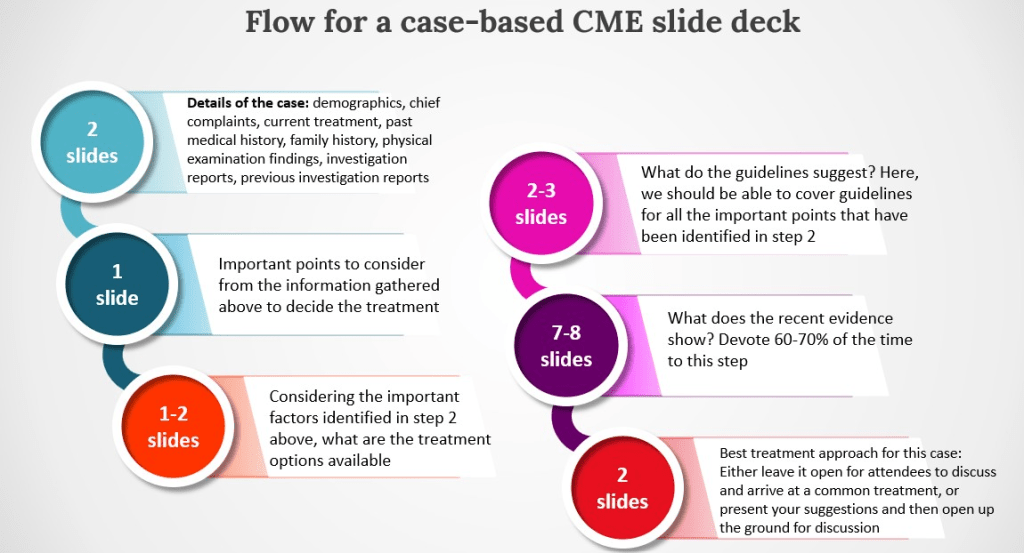
The approach in a case-based CME should mirror how a clinician would think in real-world settings. Here is a flow for a case-based CME slide deck that works very well.
1️⃣ Details of the case: demographics, chief complaints, current treatment, past medical history, family history, physical examination findings, investigation reports, previous investigation reports. Sometimes, reports might have to be omitted if there is no time for the investigations e.g., in acute settings
2️⃣ Important points to consider from the information gathered above to decide the treatment. This opens up a possibility of discussion. Attendees might have different perspectives on what data points are important.
3️⃣ Considering the important factors identified in step 2️⃣ above, what are the treatment options available. This again is likely to generate a good discussion as different clinicians would have different perspectives.
4️⃣ What do the guidelines suggest? Here, we should be able to cover guidelines for all the important points that have been identified in step 2️⃣
5️⃣ What does the recent evidence show? This is the most important part of the CME that can influence clinical practice. Devote 60-70% of the time to this step. A skilled medical affairs professional should be able to find and select the most impactful recent evidence that would make clinicians think and lead to an interesting peer-to-peer discussion. For medical affairs, this is the place to capture all the insights that might otherwise require several days of fieldwork
6️⃣ Best treatment approach for this case: There are 2 options here. Either leave it open for attendees to discuss and arrive at a common treatment, or present your suggestions and then open up the ground for discussion. Again a golden opportunity to capture insights from clinicians.
Do you think all of this requires 50-60 slides? Not at all. A maximum of 20 slides should be good enough for a 1 to 1.5 hr CME!
 MedicoMindsPro