
Part 1
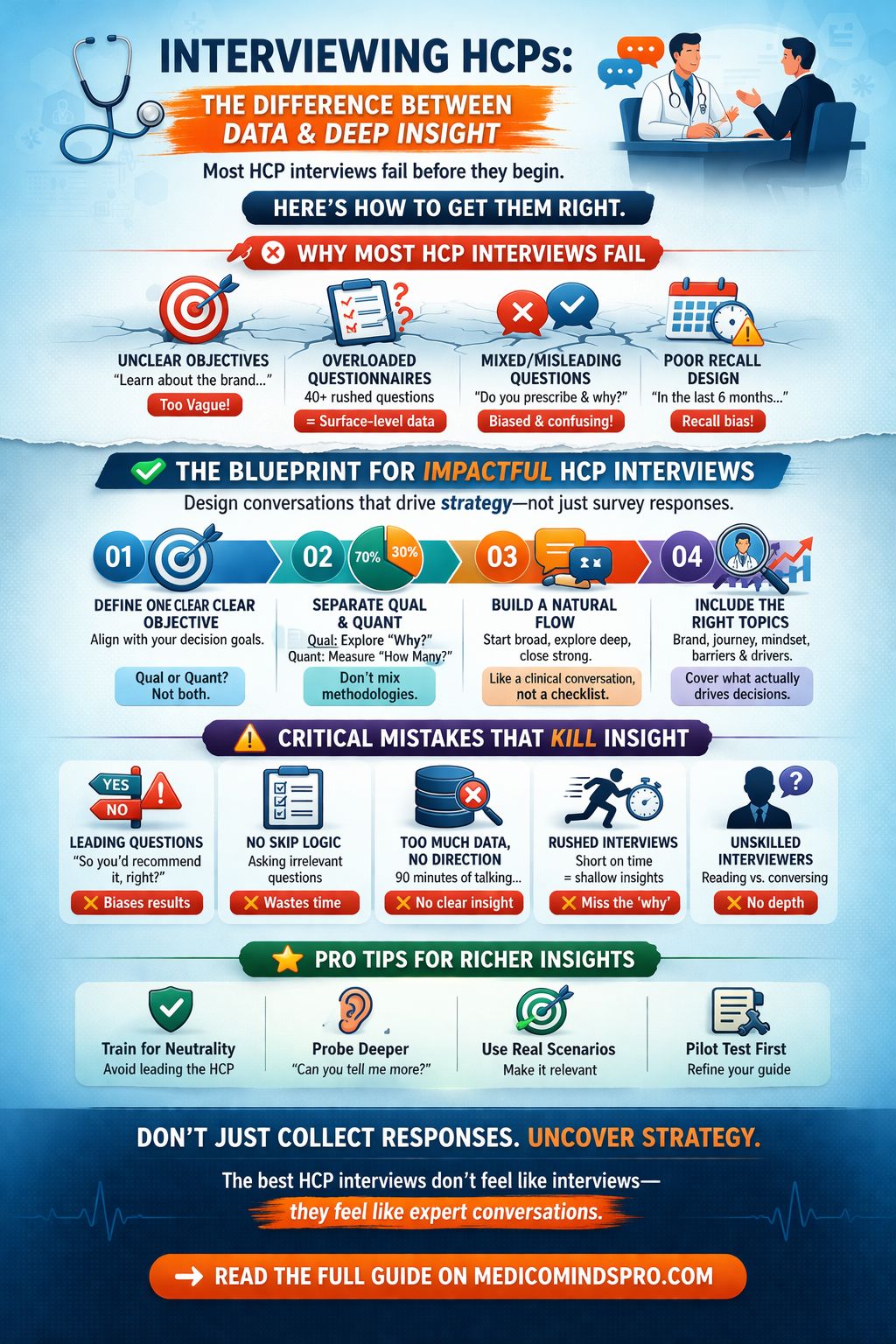
HCPs (usually doctors) are much sought after for understanding the disease, market size and opportunity, treatment preferences and challenges, patient perspectives, and many other insights by healthcare organizations (pharma and medical devices). Many strategies are often based on the insights gained from HCP interviews. Hence, it becomes imperative that precise and concrete information is obtained from such interviews because if the information that is sought is not successfully obtained, the cost of the entire exercise, including time, resources, and money of the organization and the time of the HCP, can be a heavy price to pay. Moreover, it is a lost opportunity because you cannot go back to the HCPs to seek information that has been erroneously missed. Not to mention the strategy falling flat, if that was the objective of the interviews. However, it is not uncommon to see a lack of adequate planning and much thought into ‘what are we seeking to achieve from these interviews?’ Some of the most common mistakes I have come across in conducting HCP interviews are:
- Seeking quantitative as well as qualitative insights from a single interview
- Very long interview questionnaires
- Questionnaires lacking proper flow
- Biased questionnaires
- Hurriedly listed questions without thought around whether the information will be really useful and how. Anybody with market research experience can easily spot this type of work.
- No thought behind keeping a question open-ended or close-ended
- No pilot testing of the questionnaires
- People without adequate expertise (often medical reps) are handed over the questionnaires to conduct these interviews.
- No in-house practice sessions before the actual interviews
While I will discuss each of the above errors with examples, I will explain point number 8 here because even if you avoid the first 7 errors, this one error will nullify everything else that has been done right. Medical reps are sales experts and not market research experts. We often expect them to be the jack of many trades in an effort to save costs, which I think is not only unfair but destroys the very purpose of the ‘HCP interviews’ exercise. The interviewer then often just follows the sequence of questions and notes the response of the HCP. Even the responses might not be completely noted down for they cannot often ‘catch’ all that the HCPs say. For the best returns from HCP interviews, the interview itself must flow like a conversation. The HCP should not get a feeling that (s)he is being interviewed by a person who does not know the subject/topic well because this will just fetch mechanical answers. A person with expertise will probe as and when necessary, and the interview flows like a smooth conversation between two professionals.
Before even setting out to plan HCP interviews, it is important to search the literature and familiarize yourself with what information is already available publicly so that the interviews are not futile and the questions can be planned accordingly. Once you decide you need to conduct the interviews as the information you are seeking is not adequately available in the public domain, it is important to write down what is the objective of these interviews and how the information thus obtained will be used. For e.g.,
- Will the information be used to plan the sales and marketing strategy?
- Will it be used to plan the scientific marketing strategy?
- Will it be used to plan the launch strategy?
- Will it be used to plan patient support programs?
- Will the information be used to plan future advisory board meetings?
- Are you planning to publish the information as a manuscript (HCP survey)?
Only after all the homework is done should the framing of the questionnaire begin.
In part 2 of the topic at the link below, we will see examples of the errors I have listed above and how they can be avoided.

