
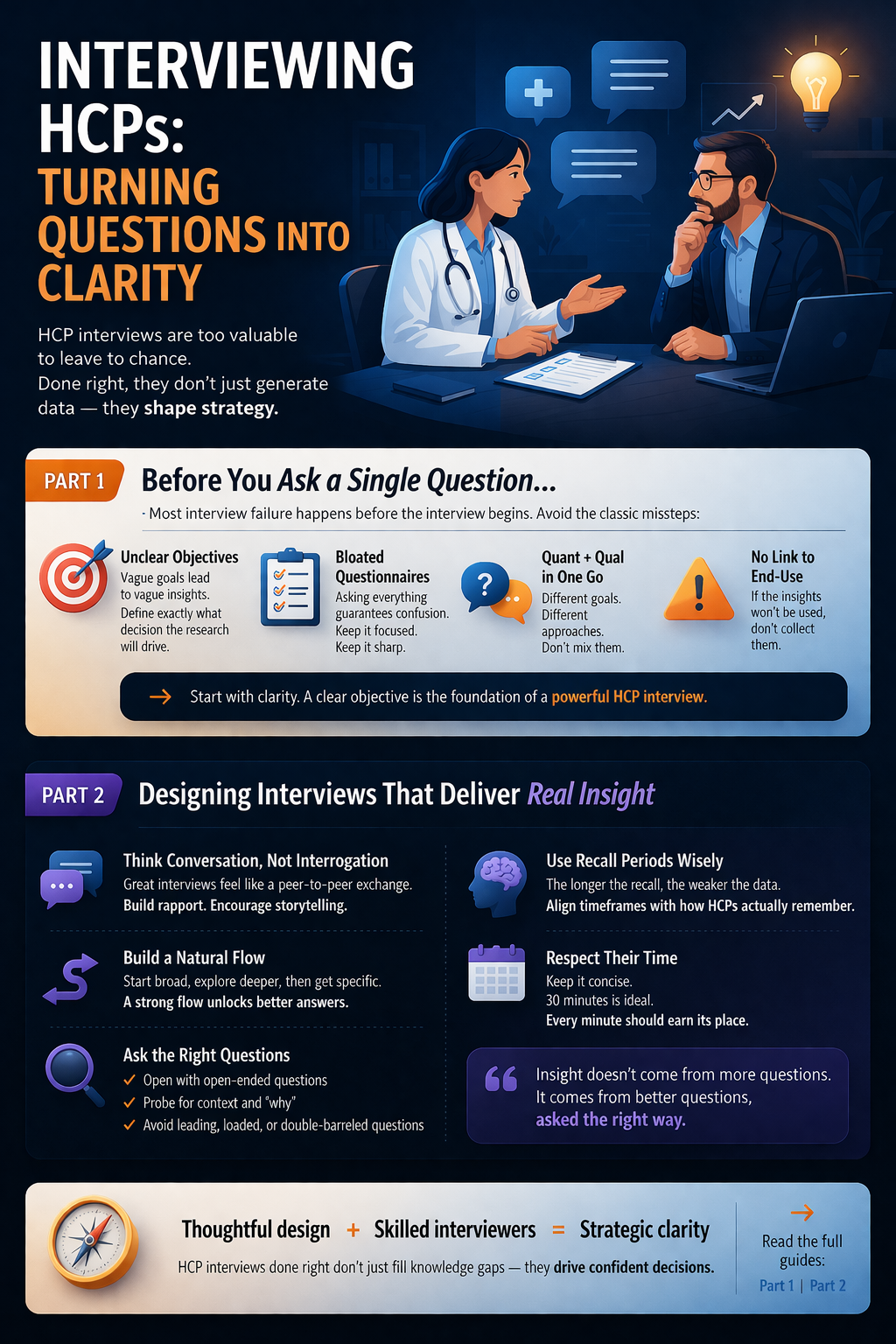
Continuing from where we left off in Part 1, let me share some examples of the common errors I mentioned in the previous part. As I had mentioned, it is very important to be clear about the objective of the interviews.
The first error I wrote about was ‘seeking quantitative as well as qualitative insights from a single interview.’ Logically, you would require quantitative information for market sizing or the likely market opportunity. In such a scenario, the questions should focus just on quantitative information. Simultaneously trying to know what is prescribed, when, and why, is like going off-track. Without knowing the market well, possibly the insights around the disease are not yet robust enough within the organization to be able to probe deeply. At such a stage, trying to combine quantitative and qualitative questions might be a wasted effort and make the questionnaire too long as well. This brings us to the second error – ‘Very long interview questionnaires.’ Let me give an actual, direct example here. I came across a 7-8 page questionnaire comprising 40 questions!!! I will not write all pages here but we will stick to the same questionnaire for examples as we proceed, so we can see the long list of errors. The first section was as follows:
- How many patients of disease ‘abc’ do you see per week?
- How many new patients of disease ‘abc’ do see per week?
- How many follow-up patients of disease ‘abc’ do you see per week?
- What is the age group of follow-up patients?
- What is the age group of new patients?
- Among all patients you see per week, what % have disease ‘abc’ ?
- What is the sex ratio of patients with the disease ‘abc’?
Let us stop here for a moment. Would an HCP remember how many patients with a particular disease (s)he sees per week? Depends on which disease you are asking about. If the questionnaire is about something like a cough-cold, a week might be too long. Asking about a day might be better. Whereas for a disease like Parkinson’s, a week might be too less, and it might be good to ask for monthly data. Now let us see Q2 and 3. After Q1 and 2, isn’t Q3 redundant? In fact, asking it might appear foolish. Also, neither Q2 nor Q3 would help in arriving at the likely prevalence of the disease or projected prevalence. I was not sure what was the objective behind these questions. (This is an example of error 5 that I mentioned in the previous part- ‘Hurriedly listed questions without thought around whether the information will be really useful and how’). Now coming to Q4. How would the information from Q4 help? If you think that people beyond a certain age group do not follow up or that the disease usually remits after a certain age, wouldn’t it be better to ask a more specific question?
Further, the questionnaire proceeded somewhat like this: Which are your preferred drugs in the treatment of disease ‘abc.’ Rank them as 1, 2, 3, 4, 5, 6, 7 (1 being most preferred & 7 being least preferred). Names of 7 drugs were listed. The results of the analysis looked like this- 40% of the HCPs preferred drug A as their first choice, 25% preferred it as their second choice, 20% preferred it as their third choice, and 15% as their fourth choice. The same continued for all drugs (Listed A to F). Imagine trying to draw some insight from such data. What would be the take-home message? The ranking was totally avoidable. A simple open-ended question asking HCPs to list 3 drugs in their order of preference would have been better. This was error number 6 mentioned in the previous part- ‘No thought behind keeping a question open-ended or close-ended.’ Ideally, it would have been good to also end the interview here. Generally, an interview should have no more than 10 to 12 questions because the interviewee will lose interest beyond this. quantitative research questionnaires do not require much probing either. But it does require someone with experience if the responses are going off-track to subtly bring the conversation back on course.
The same questionnaire further proceeded as- What is the reason for your choice of the first-line treatment mentioned above? Similar questions were asked for the second and third lines. While the flow is alright here, it is getting into qualitative insights here and this is where the interviewer’s expertise is important. There could be so much to know here that this could be an interview-cum-conversation in itself and provide a wealth of information like which patients profiles are given which drug, which profiles are not given xyz drug, the sequential order in which drugs are prescribed based on patient profile etc. That is the reason quantitative and qualitative insights should not be sought from a single interview.
Further, the questionnaire asked the HCPs to list down the treatment prescribed to the last 15 patients of the disease ‘abc’ treated by them. One, would any HCP seriously remember this kind of data? Two, what is the objective and use of obtaining such information without knowing the detailed patient profiles? This indicates no thought behind framing questions and a very poor flow as well. The next section focused on questions about a particular drug. When it was given, which patient profiles, advantages, disadvantages, doses, adverse effects, efficacy, and others. It was now very clear that the objective of the interview was to understand the prescribing habits related to a particular drug only. So the above sections were completely avoidable. There is nothing wrong with trying to understand prescribing habits related to a particular drug if it is for framing the company’s strategy accordingly. However, in this case, the company intended to publish the analysis as a survey about the disease ‘abc.’ In such a scenario, the questionnaire appears completely biased as most questions are related to a particular drug and others have been completely ignored. At best, it could be published as a survey related to the specific drug but not to the disease.
When you are conducting a survey with an intent to publish it, the approach needs to be completely different. There are a number of hurdles you will face at the publication stage and the mitigation plans need to be in place. You explain to the journal reviewers, the basis on which the number of HCPs interviewed was selected. In the above questionnaire example, what insights/ outcomes would one be able to write about the preferred therapies with the rankings-based question completely messing up the data? Why was information related to only one drug sought? Most importantly, if you wish to publish survey results in a journal with a good impact factor, they will invariably ask for a certificate of validation of the questionnaire. For validation, one needs to involve a statistician at the stage of planning the questionnaire. This needs to be followed by pilot testing and based on the answers obtained during the pilot test, the statistician will suggest any tweaking of the questionnaire if necessary and accordingly provide a validation certificate or ask for another round of pilot testing after the changes.
Lastly, in the above example, medical reps were given out this questionnaire. Most handed it out to the HCPs who filled some questions, did not fill others, some misinterpreted the rankings questions as 7 being most preferred etc.
Some steps are absolutely essential before conducting HCP interviews. Despite clear objectives and well-thought-out questions, things can fall out of place. Hence, it is good to first do a couple of dummy interviews in-house with colleagues and see what information comes through and whether you will be able to use the data. Next, pilot test the questionnaires with at least 5 to 8 HCPs. This will help see real data in front of your eyes and make you realize whether something needs to be added, deleted, or modified. Most important- medical reps should not be expected to conduct interviews. It is not their job and it is a waste of their resources as well as the company’s resources. Last but not least- whoever conducts the interviews needs to practice and have good knowledge of the therapy area to be able to probe wherever necessary and make it a conversation rather than an interview.

