
Part 1
Every pharma/medical devices marketer knows and understands the importance of a medico-marketing strategy. It is perhaps one of the most important activities every year and a lot of planning and hard work goes into it. Yet it continues to be challenging- one, because the market is dynamic like in any other industry, and two, because the product is not sold to the end-user but to an influencer who is sharp, intelligent, and far more educated than the seller. Nevertheless, as a medical affairs professional, personally for me creating a medico-marketing strategy is the most exciting part of the work in this industry.
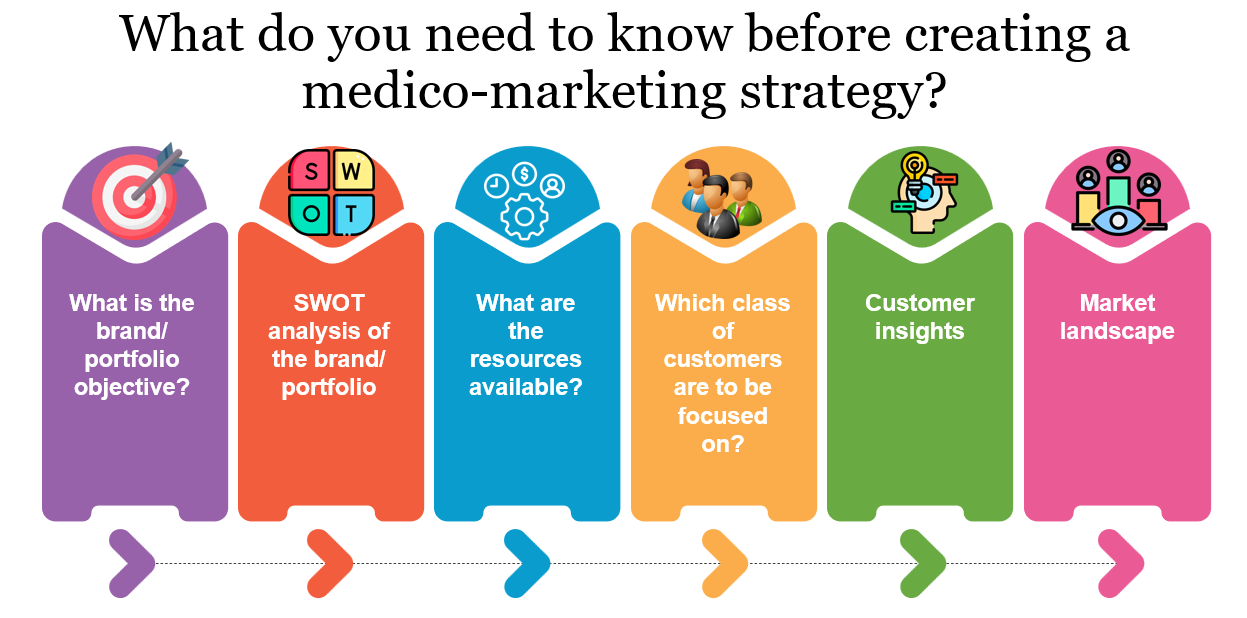
No marketing plan can be made merely by sitting at a desk and thinking of brilliant ideas, and if done so, is a sure recipe for failure. There is an interplay of multiple factors that goes into creating the plan. We look at some of these important factors that need to be considered before creating a medico-marketing plan.
- What is the brand/ portfolio objective? As a marketing or medical affairs professional, one might be managing one brand but there might be other brands in the portfolio as well. The objectives of both need to be considered in order to be realistic about achieving one’s own brand objective. A brand might have various objectives. Some examples are achieving a target of xyz, achieving a growth of x%, increasing market share by x%, becoming the number 1 brand in the market in the given category, achieving an x% share of voice, being prescribed with another product, etc. Based on the objective, the plan needs to be strategic, yet practical enough for implementation. In a portfolio, if the brand is at number 3 in the organization’s order of priority, the budget allocation will be lower than for those at number 1 and 2 in priority and the brand at number 3 sometimes might not even be detailed in an HCP’s chamber if the rep is allowed to present only 1 or 2 brands. Hence, the practicality of implementing the strategy needs to be borne in mind.
- What are the resources available? Other than the budgetary allocations, other resources like manpower, customer list, digital resources, and scientific resources need to be considered because a strategy heavily dependent on a resource that is inadequate is sure to fail. An example is a digital resource. A business unit might have built a state-of-art digital resource for its customers but strategically, the plan might be to devote the lion’s share of the focus to the brands at number 1 and 2 in the order of priority. In such a scenario, if the medico-marketing strategy of the brand at number 3 in the order of priority heavily relies on digital marketing through this resource, it is unlikely to succeed.
- SWOT analysis of the portfolio. This is a huge topic in itself, which we will cover in part 2. In fact, no medico-marketing strategy can be created without doing a SWOT analysis.
- Customer insights. This is the most important part. As mentioned at the beginning of this article, no marketing plan can be made merely by sitting at a desk and thinking of brilliant ideas. A SWOT analysis done without obtaining customer insights is no SWOT analysis. Here again, the discussions that HCPs have/might want to have varies based on who is at the other end. There is a clear distinction between what gets discussed with the medical rep, the marketing personnel, and the medical affairs personnel. For a robust medico-marketing plan all 3 perspectives are important and it has to be a teamwork for the plan to succeed. Afterall, the marketing team will drive the implementation and the sales rep will be the frontline executioners of the strategy. A medical affairs professional who is out to create a strategy based only on the customer insights shared by the sales and marketing colleagues might miss something important and the direction of the strategy might go awry. It is as important for medical affairs to have relationships and discussions with HCPs as it is for the sales and marketing teams. There is a lot to learn from them if you are able to engage them in a scientific conversation. There are subtle ways of learning what they prescribe- why and why not, what they would like a product to have, how we can partner with them for better education of patients and paramedics, and most importantly the current disease epidemiology, the future outlook, the challenges in treatment etc. Even if the sales, marketing, and medical affairs professionals ask the same questions, one can definitely see the difference in the depth of responses and discussions. A medical affairs professional is more of a peer for the HCP and the discussion would be more along scientific lines.
- Which customers should be focused on? Not every strategy needs to be pushed to or executed through class 1 KOLs. Hence, having absolute clarity about the brand objective, SWOT analysis, and customer insights is important.
- Market landscape- other than the market size and growth, new launches, competitor pricing, and such other numerical data, which is important and easy to obtain, the more important part is the qualitative insights. What are the competitors communicating? What are the guidelines saying? Is there an indication of when the new guidelines are likely to be released and what is being discussed in the international community, which might be reflected in the next guidelines too? Hence, having a regular pulse on local and international conferences and publications in indexed peer-reviewed journals is important. What are the new product launches expected and how are they likely to affect the current products? The regulatory changes is another important perspective. In countries where the cost of treatment is borne by insurance companies, the payer concerns also need to be probed.
It is hardly surprising that creating a medico-marketing strategy is such a mammoth exercise and if done diligently, requires at 2-3 months from beginning to end. In part 2, we will have an in-depth look at the SWOT analysis.
 MedicoMindsPro