
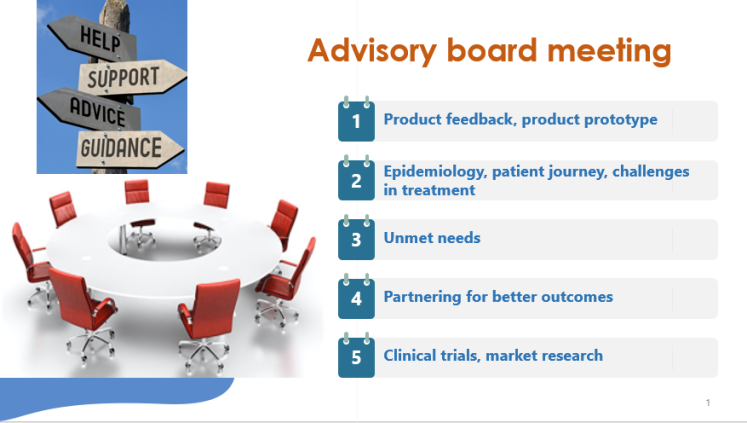
Advisory boards are possibly one of the most important forums in pharma and medical devices and serve several important purposes. Right from getting feedback on the product, understanding the patient journey, understanding unmet needs, challenges with using the product, suggestions for improving the product, current trends in the epidemiology and management of a particular disease and challenges in treatment, feedback on the prototype of a new medical device, seeking suggestions on how the organizations can partner with the institutions and caregivers for initiatives that can help HCPs provide better outcomes, planning clinical trials, sharing outcomes of a study and many others. It is also one of the most important forums for building KOL relationships.
With so much at stake, and getting all members of the advisory board to be available at a common date being so difficult, much work needs to go into preparing for an advisory board meeting. The first task is to set the objective of the meeting. Conducting a meeting just because a business unit thinks that we need to ensure at least one meeting every year, is an exercise in futility. Not only is it a waste of resources but the board members can easily sense that the meeting had no particular direction and participation is likely to decline in future meetings. The KOLs are experts in their field, and it is important to respect their time and value. It is also very important that among the entire marketing and medical affairs teams, a close rapport between each KOL with at least one member should exist. This is important for one-to-one discussions to seek their suggestions on the proposed objectives and frame the agenda as also roll out the initiatives after the meeting. Many times these KOLs are also good sounding boards when the team is trying to toss ideas that can be taken up for discussion at the meeting.
Once the internal team has narrowed down the objective(s) and a draft agenda for the advisory board meeting, it is always good for a member from the marketing and/or medical affairs team to meet each member one-to-one and seek their suggestions. This ensures that each member feels valued even before the actual meeting and participates in the discussion during the meeting. An advisory board usually has a chairperson appointed at the time of the creation of the board, and usually, the seniormost and most experienced person is chosen to avoid conflict. Of course, this might change if the composition of the board is changed in the future. However, at times only seniority and experience are not adequate. The chairperson has to be someone who is well known and accepted among his/her peers and is looked up to. Most important, at least one person from the marketing/medical affairs team ‘MUST’ have a very good relationship with the chairperson to ensure a smooth meeting and to control or bail out through difficult situations. The chairperson can also be requested to perform the role of a moderator depending on the agenda of the meeting. This is a delicate balance to strike, and the insights about the dynamics between the members would be known in the sales team. Including the sales team in the discussions is important. Once the name of the chairperson has been decided by the internal team, it is good to apprise each member about the same during a personal visit rather than spring a surprise during the meeting. Needless to mention, a date has to be decided by mutual consent of all participants. With these steps, the operational plan is in place.
Now comes the most important part – deciding the presenters and creating the slide deck. Often, the tricky question is who should present- someone from the company or the KOLs or both? There is no fixed answer here. It depends on the objective of the meeting. However, there needs to be a definite plan; you can’t leave loose ends. Usually, for sessions like seeking feedback on the prototype of a new product, seeking suggestions on improvement of the product, sharing the results of any market research conducted by the company, or seeking suggestions for partnering for new initiatives it is better for the company representative to present. However, 80% of the time allocated for the session must still be given to the KOLs to share their thoughts. It is important for the presenter not to get carried away and hog the session. Keep the number of slides to a minimum. It is also important that every member’s opinion is sought and one or two members do not dominate the discussion; hence, it is good if the moderator is the chairperson. Even when the presenter is a KOL, they usually seek help from the company to prepare the slides. This is in fact good because there are no surprises for the company’s members during the meeting. It is also good to have a sort of mini dry run with the presenter after preparing the slides- again the objective is to strike a balance between the time the presenter takes and what is left for the participants.
Another important activity is for someone from the company to take notes during the meeting. If it is being recorded, it is needless to say that it should be with the members’ consent. However, despite recording, taking notes is important. At the end of every session, somebody from the company should summarize the session so that everyone is aligned. That is where the notes are helpful. Similarly, at the end of the meeting, summarizing the meeting and agreeing on the actionable items is important.
The last and most important part is creating a professional report of the meeting. You will find this as a separate topic in the link below.
More resources on advisory boards
Using technology to make advisory board meetings more productive and insightful
 MedicoMindsPro